
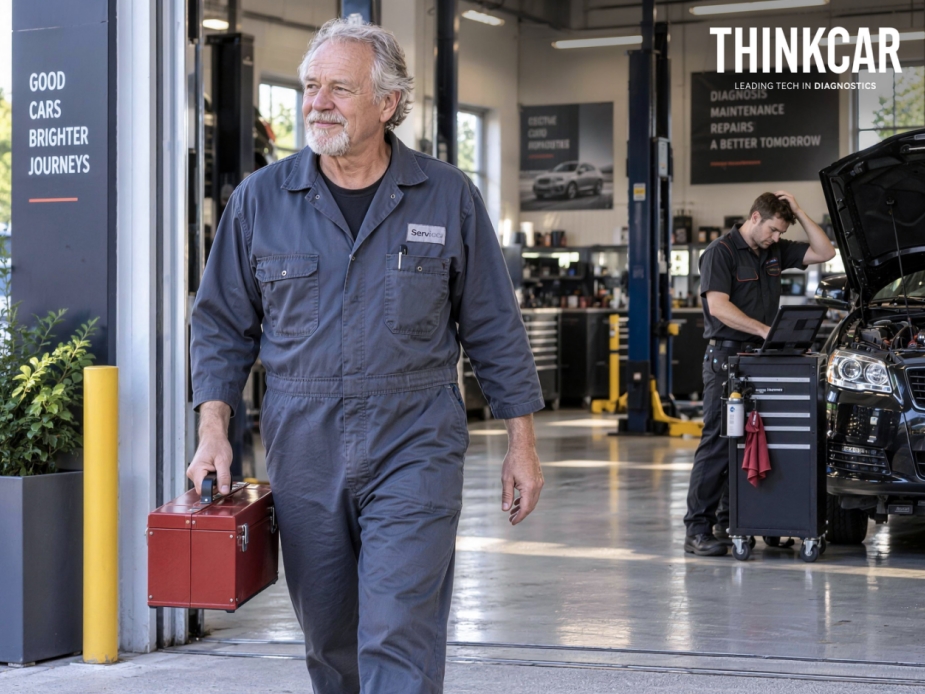
New York, USA - September 22, 2026 - The independent repair sector is aging in place. Across the United States and Europe, the owners and master technicians who built family-run and independent shops are approaching retirement, while the pipeline of trained successors thins. The result is a quiet succession crisis: when the person who holds the shop's hardest diagnostic knowledge steps away, that knowledge often leaves with them — and so, for many owners, does the retirement plan built into the business.
A sector built around people who are leaving
The automotive technician shortage is already a daily reality in 2026, not a future projection. In a September 2025 survey of roughly 700 U.S. general repair shops by PartsTech (an OEC company), 59% said the shortage had a high or moderate impact on the business, and 46% expected it to worsen over the next five years. The U.S. Bureau of Labor Statistics projects about 70,000 openings for automotive service technicians and mechanics each year on average through 2034, with retiree replacement a major driver. The OEC/PartsTech analysis adds that the industry will require nearly 1 million new entry-level technicians over the next five years, as the average technician age sits at 40 and retirements accelerate. The two gauges differ in scope: BLS counts annual job openings from growth and retirements, while the OEC/PartsTech estimate covers total new entrants needed to refill a shrinking workforce.
- The baby-boomer technician workforce is retiring at a rate estimated as high as 9% annually, according to the PartsTech/OEC analysis.
- In the United Kingdom, the Institute of the Motor Industry reports nearly half (47%) of automotive employees are over 45 and forecasts that 144,000 of today's workforce could retire by 2032, against roughly 19,000 current vacancies.
The real asset walks out the door
For many independent owners, the shop is the retirement plan. A 2017 Manta survey of 1,960 small-business owners found that 34% had no retirement savings plan in place, and an equal 34% had no succession plan for their business — yet many owners still treat the eventual sale of the shop as the cornerstone of retirement. The problem is that a shop's true value often lives in the owner's head — the diagnostic instincts, the vehicle-specific fixes, the way the work has always been done that was never written down.
Succession advisers are blunt about the risk. As the Automotive Training Institute notes, a method that exists only in the owner's mind leaves a buyer with no proof the business can repeat its success, which depresses both sale price and the odds of a clean handover. Documenting processes and building systems that run without the founder is what turns a job into a transferable business. Industry brokers echo the trend: Ratchet and Wrench reporting points to rising consolidation and warns there will be fewer independent repair shops as owners retire, with consolidators circling the businesses that lack a successor.
The apprentice paradox
Even where young technicians do join, they rarely stay long enough to absorb the knowledge. The supply gap is stark: TechForce Foundation's 2026 Supply, Demand & Opportunity Report finds the U.S. needs 241,842 new technicians each year across ten sectors, while post-secondary programs graduate only 101,743 — a 58% supply gap. For automotive specifically, annual openings of about 70,000 outpace roughly 42,000 graduates. The report's own finding is that the bottleneck is recruitment, not retention — too few entrants, not a mass exit of experienced hands — yet that thin incoming pipeline is precisely what leaves shops leaning on their longest-tenured technicians.
The friction is structural. Younger technicians weigh pay, culture, and a clear path to advancement, and they watch how senior techs are treated; experienced techs, pressed for billable time, often will not or cannot formalize the training that would pass their skill along. In the PartsTech/OEC survey, limited access to training was named by 14% of respondents as a cause of the shortage. The outcome is a loop: a thin pipeline prevents knowledge from accumulating, and unaccumulated knowledge makes the shop dependent on its oldest hands — exactly the people preparing to leave.
A fallback that does not retire: AI as the shop's second brain
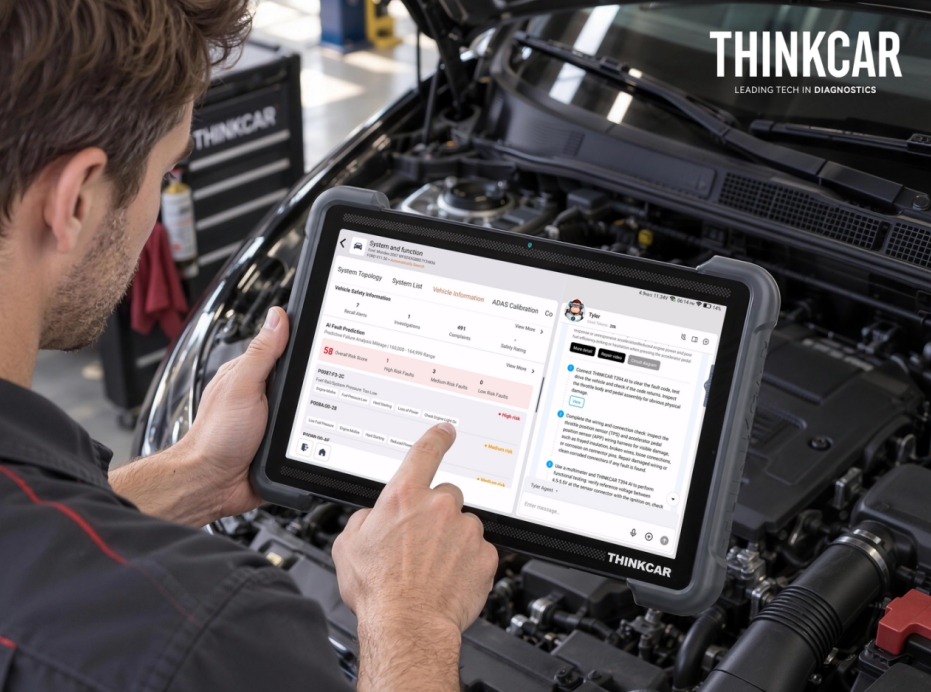
One answer gaining traction is to codify diagnostic reasoning in the tool itself. The THINKCAR T394 AI pairs a full-system diagnostic tablet with Tyler, an AI diagnostic agent that turns raw vehicle data into a clear, actionable repair path. Instead of returning a fault code and leaving the technician to interpret it from memory, the device reasons through the fault and proposes the next step — so the diagnostic method is captured in the workflow rather than held by one person.
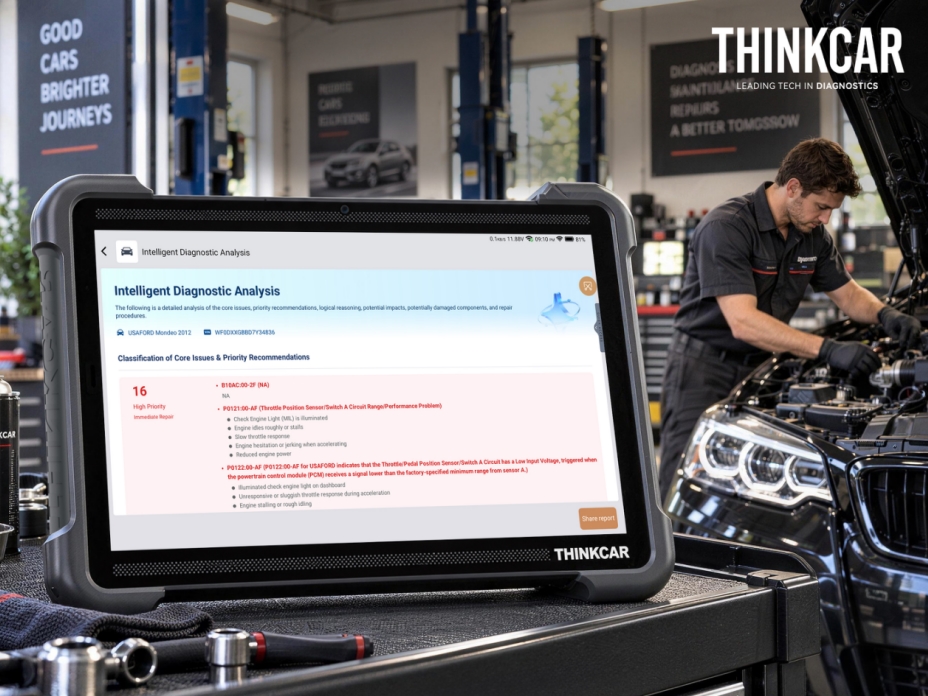
It runs on ThinkLLM, THINKCAR's in-house diagnostic model, and is orchestrated by ThinkClaw into specialized agents — System Diagnostic, Maintenance, Fault Analysis, and TCOS Navigation — that reason through faults rather than return generic answers. The design moves away from the confident-but-unverified responses that undermined early diagnostic chatbots, toward evidence-anchored guidance drawn from 48 million EPC parts records, 375,000 standardized repair procedures from Solera AutoData, and a knowledge base of over 100 million diagnostic records and cases, based on THINKCAR internal data.
- Younger technicians reach productive work faster, because the diagnostic logic is on the device, not locked in a mentor's head.
- The owner's method persists in the workflow, so the shop stays capable through staff changes and ownership transitions.
What it means for the independent aftermarket
The timing matters beyond any single shop. According to Global Market Insights, the AI-powered automotive diagnostic market is projected to reach USD 6.9 billion in 2026, a signal that agentic diagnostics is moving from novelty to shop-floor standard — and tools like the THINKCAR T394 AI with Tyler are what put that capability into an independent shop's hands. For an aging trade, the question is no longer only who will turn the wrench next, but what stays behind when they do.
Availability
The THINKCAR T394 AI is expected to be available through authorized THINKCAR dealers starting in October 2026; for product specifications and to find a local authorized dealer, visit thinkcar.com.
Frequently asked questions
What is Tyler?
Tyler is THINKCAR's AI diagnostic agent. It runs on ThinkLLM, THINKCAR's in-house diagnostic model, and uses a multi-agent architecture — including System Diagnostic, Maintenance, Fault Analysis, and TCOS Navigation — to reason through vehicle faults and generate repair guidance.
How can AI diagnostics help an independent shop's succession?
When diagnostic reasoning is captured on the device instead of held by one technician, younger staff become productive faster and the shop's capability persists through staffing and ownership changes. Rather than removing the technician from the loop, the tool augments judgment with evidence-anchored guidance.
About THINKCAR
Founded in 2019, THINKCAR is a leading provider of AI-powered automotive diagnostic solutions. With AI patents and a nationally registered automotive AI algorithm, THINKCAR serves 3.5 million users across 215 countries and regions. Its product ecosystem spans 8 categories including diagnostic tools, TPMS, ADAS calibration, EV diagnostics, and remote service platforms.
The T394 AI, its flagship Tyler-powered tablet, will be available through authorized dealers — visit thinkcar.com for details. Separately, the THINKSCAN 689BT PRO and MUCAR 892BT PRO — a more affordable AI diagnostic lineup separate from the premium THINKCAR T394 AI — are sold online via mythinkcar.com
Sources & Methodology
PartsTech / OEC, U.S. General Auto Repair Shop Survey Report, September 2025 (approximately 700 U.S. repair shops).
U.S. Bureau of Labor Statistics, Occupational Outlook Handbook — automotive service technicians and mechanics, employment openings and projections through 2034.
TechForce Foundation, Supply, Demand & Opportunity Report (2026): 241,842 annual technician openings vs 101,743 graduates across ten sectors (58% supply gap); automotive ~70,000 annual openings vs ~42,000 graduates.
Institute of the Motor Industry (IMI), automotive workforce age profile and retirement projections, United Kingdom.
Manta, 2017 small-business retirement survey (1,960 owners): 34% no retirement savings plan, 34% no succession plan; Automotive Training Institute (ATI), shop succession and retirement-readiness commentary; Ratchet and Wrench, industry consolidation and succession reporting.
Global Market Insights, AI-powered automotive diagnostic market projection, USD 6.9 billion in 2026.
THINKCAR internal data: 48 million EPC parts records, 375,000 standardized repair procedures from Solera AutoData, and over 100 million diagnostic records and cases.
Media Contact
Company Name: THINKCAR TECH CO., LTD.
Contact Person: Jackie Lan
Email: Send Email
Country: China
Website: www.thinkcar.com